
Seaport Magazine #5 – 2025
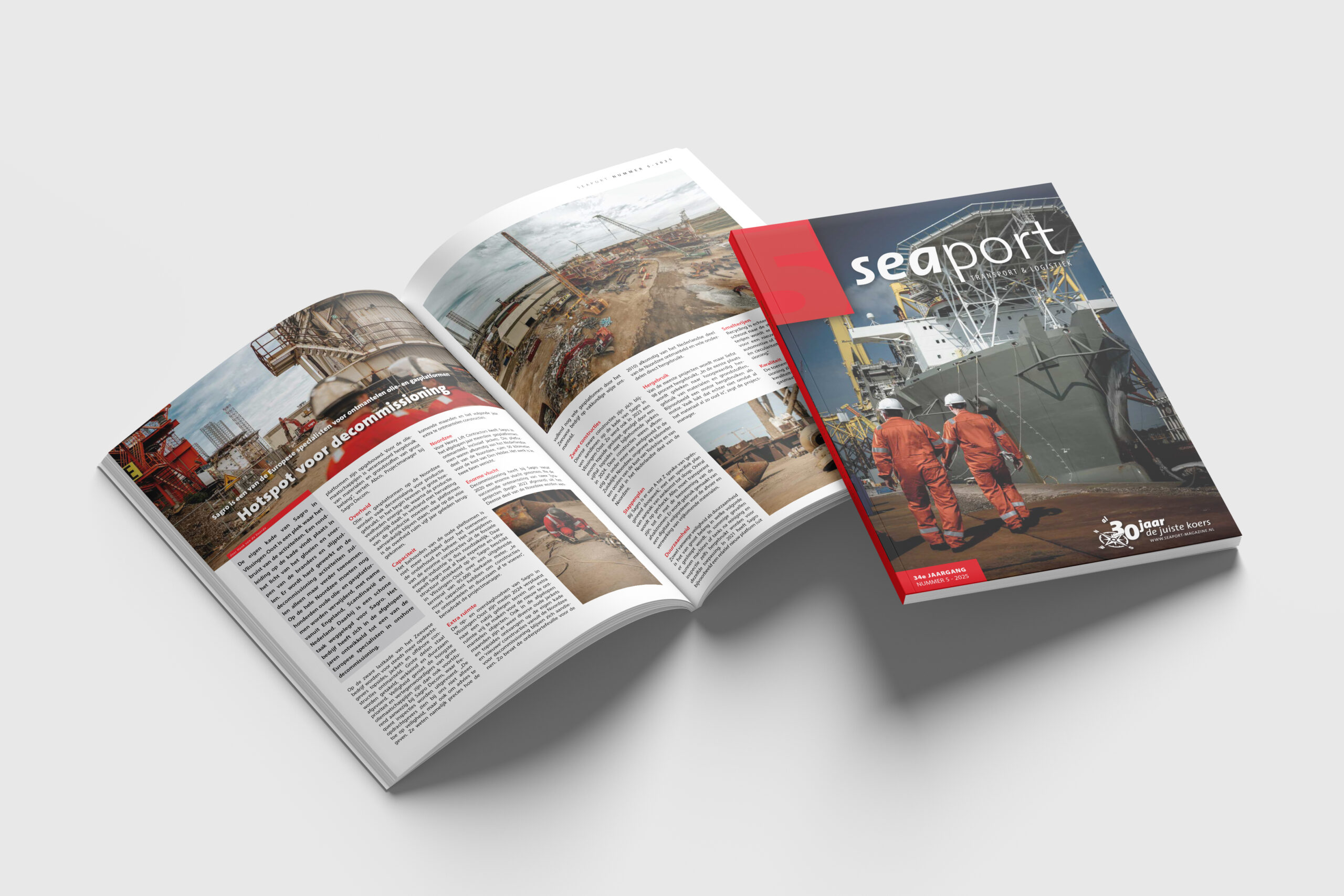
Sagro is one of the European specialists in dismantling oil and gas platforms
Sagro’s own quay in Vlissingen-Oost is a place buzzing with activity. A tour along the quay takes place in the glow and sharp sound of cutting torches and grinders. Work is carried out intensively, and decommissioning activities are expected to increase even further in the coming years.
Across the entire North Sea, hundreds of old oil and gas platforms still have to be removed, particularly from the waters of the United Kingdom, Scandinavia, and the Netherlands. This is where Sagro plays an important role. Over the past few years, the company has developed into one of the European specialists in onshore decommissioning.
At the heavy-load quay of the Zeeland-based company, topsides, jackets, and other offshore structures are dismantled for an increasing number of clients. Large steel components are lifted, cut into smaller sections, and disposed of sustainably. Safety has the highest priority, and representatives of major oil companies are therefore continuously present at Sagro Decom, where frequent inspections take place.
“Clients not only monitor safety here but also provide advice. They know exactly how the platforms were constructed. For the oil companies, responsible reuse of materials and raw resources is extremely important,” says Abco, Project Manager at Sagro Decom.
For heavy lift contractors, Sagro dismantled several gas platforms last year, including jackets. These platforms came from the Dutch sector of the North Sea, more than 50 kilometers off the coast of Den Helder. The work was carried out in two phases.
Government policy
Oil and gas platforms in the North Sea are often used for production for decades. At first they generate large amounts of energy, after which production gradually declines.
In the past, the platforms were sometimes left in place in case production could be restarted. However, the government abandoned that policy more than five years ago.
Capacity
Keeping old platforms in place is no longer economically viable because of increasing maintenance and management costs. Removing these massive structures from the fossil energy industry has therefore become necessary.
Sagro responds to this development with its expertise and infrastructure. In Vlissingen-Oost the company operates an extensive terminal covering 95,000 square meters.
“You need sufficient capacity to dismantle these structures and dispose of them in a sustainable way,” the project manager emphasizes.
Extra space
The storage and transshipment warehouses of Sagro in Vlissingen-Oost were relocated to a nearby site in mid-2024 to create additional space for newly arriving structures to be dismantled. In recent months, several old jackets and topsides have again been received at the company’s own quay, and “new” structures from the North Sea continue to arrive for decommissioning. The order portfolio for the coming months and the following year therefore includes additional structures that will be dismantled.
North Sea
For Heavy Lift Contractors, Sagro dismantled several gas platforms over the past year, including jackets. These platforms originated from the Dutch sector of the North Sea, more than 50 kilometres off the coast of Den Helder. The work was carried out in two phases.
Rapid Growth
Decommissioning activities at Sagro have grown rapidly since 2020. After the successful dismantling of two Tyra projects (completed in early 2022) from the Danish sector of the North Sea, many additional gas platforms were professionally dismantled by the Zeeland-based company.
Heavy Structures
Various heavy structures have continued to arrive at Sagro’s quay in Vlissingen-Oost. In 2023, for example, a massive topside was dismantled, followed by five topsides with their associated jackets in 2024. These structures originated from, among others, a natural gas field in the Southern North Sea, approximately 48 kilometres east of the Yorkshire coast, as well as from a field in the Dutch sector of the North Sea.
Step-by-Step Approach
At Sagro, dismantling is fully engineered from A to Z, following a specific plan of action from arrival to demolition. Every aspect is checked. Everything must be transparent, including the final destination of all waste streams. A digital tracking system is used to monitor the removal and processing of released materials.
Sustainability
Both safety and sustainability play an important role in determining the order in which dismantling takes place. In some cases, machines or tanks can even be reused for the same application after cleaning and inspection. For example, in 2021 Sagro dismantled a relatively new platform (built in 2010) from the Dutch sector of the North Sea, with many components being reused directly.
Reuse
From most projects, as much as 98 percent of the material is reused. “First we look at high-value reuse of materials and raw resources. For example, reusing an engine as an engine. However, this is often not possible because the material is already quite old,” says the project manager.
Smelters
Recycling is therefore essential. All scrap metal is sent to steel plants. “In the smelters it is turned into new steel that can begin a new life in sectors such as automotive or ICT. Safety, sustainability and circularity are central to decommissioning.”
Quality
The increasing demand for decommissioning is closely linked to the high quality standards maintained by Sagro. Both oil and gas companies and heavy lift contractors impose strict safety requirements and attach great importance to quality. Safety always comes first. The fact that various structures from other countries are transported to the location in Vlissingen for decommissioning speaks for itself. In recognition of its outstanding quality standards, Sagro received a Safety Recognition award in 2023 for the successful Tyra decommissioning project.
Labour Market
Decommissioning requires specialist skills. While hydraulic shears can handle lighter metals, the thickest steel sections must be cut using cutting torches. Experienced burners and welders are indispensable for this type of work. At the same time, labour shortages are also being felt in this sector. Sagro is therefore actively looking to strengthen its workforce, ranging from project engineers to site supervisors, welders and burners.
Project Engineer
“From technically trained professionals to young entrants who want to develop their skills in practice, we welcome everyone with the right expertise. We recently hired someone as a project engineer who had just graduated from HZ University of Applied Sciences. We also regularly have interns from HZ or Avans gaining experience with us. For students and starters, the work offers a great behind-the-scenes look at a sector that is constantly evolving and directly contributes to the energy transition.”
Reverse Construction
Abco continues: “It is varied work. ‘Demolition’ may not sound very attractive to people who studied engineering, but decommissioning actually involves a great deal of engineering. Demolition is essentially reverse construction. Dismantling massive steel structures must also be done carefully. For example, calculations have to be made and cutting plans must be developed: how do you dismantle structures into manageable pieces without them tipping over or collapsing?”
Safety
Safety is always the guiding principle. The HSE specialists at Sagro ensure that employees can safely access the platforms without the risk of falling or tripping. For safety reasons, additional lighting is sometimes installed on the topsides.
Demolition Yard
A demolition yard obviously operates differently from a fabrication yard. Smoke, for example, is inherent to demolition and cutting work. It is possible to try to regulate everything in advance through protocols, but it remains demolition work. Safety always has the highest priority, but decommissioning is different from working in a production environment or carrying out regular building demolition. Open flames are simply part of the job.
On the Work Floor
“We often deal with working at height, internal transport and hot work. A safe working environment is therefore essential. We have many discussions about how to handle the structures on the quay as safely as possible. What are the risks? What about permits and procedures? The clients closely monitor whether everything is done correctly. At the beginning, a lot comes your way, partly because there is no real ‘decommissioning handbook’. But you quickly learn on the job,” says Giovanni (27), who has been working as a safety specialist at Sagro Decom for about a year.
Challenging Work
“I first worked in process technology and as a fire watch. After further training as a safety specialist, I started working at Sagro in the field of Health, Safety and Environment (HSE). It is very challenging work with a lot of client interaction,” the safety specialist concludes.
“You need sufficient capacity to dismantle these structures and dispose of them in a sustainable way.”
Abco Liek